How to Use AI to Write Facebook Group Posts That Get Engagement
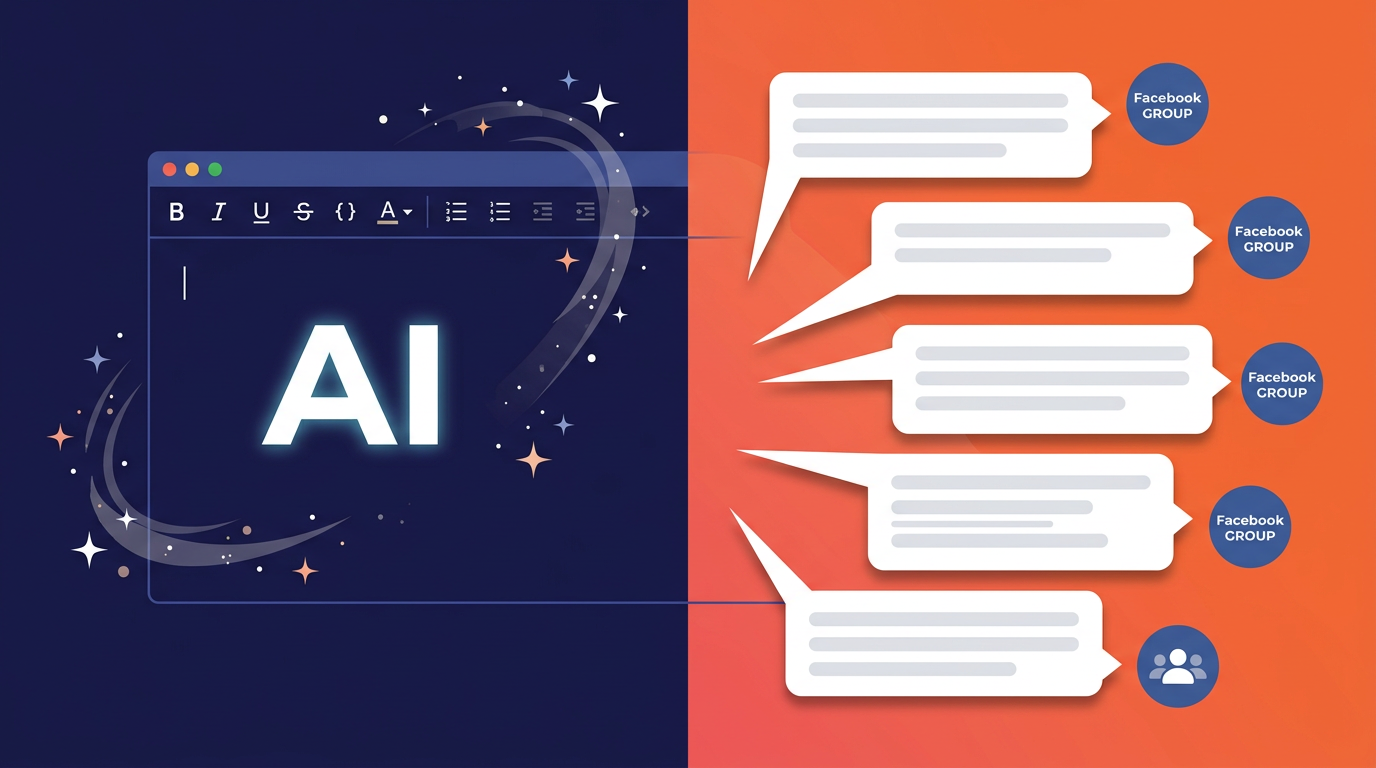
AI writes better Facebook group posts than most people do manually, as long as you give it specific context: your product, your target audience, the type of group, and the goal of the post. For multi-group campaigns, AI variation rewrites your post for each group automatically so no two posts look identical. This protects your account and often improves engagement because varied phrasing reaches different people differently.
Writing one Facebook group post manually takes maybe 10 minutes. Writing 50 variations of that post — different openings, different angles, different CTAs — would take most of a workday. AI compresses that to seconds.
But most people using AI for social media content are doing it wrong. They write a vague prompt, accept whatever comes out, and post something that sounds like every other AI-generated post in every other group. The result is content that gets ignored or removed.
This guide covers the right approach: how to give AI the context it needs to write posts that actually sound human and get engagement, and how AI variation in NinjaPoster handles this automatically when posting to hundreds of groups.
Why AI Works for Group Posts (When Done Right)
Facebook group posts have a specific structure that AI handles well: a hook, a problem or insight, and a soft CTA. That’s a tight format with a clear goal. AI excels at producing variations on a tight format because it understands the structure and can rephrase the same idea dozens of different ways.
Where AI fails is when the brief is too vague. “Write a Facebook group post about my business” gives the AI nothing useful. It fills in the gaps with generic language — the same language that every other AI-generated post uses.
The difference between AI posts that get engagement and ones that get ignored is almost entirely in the prompt.
NinjaPoster's AI-integrated posting feature rewrites your post for each group automatically during a campaign. You write one base post and the AI varies the wording, structure, and phrasing for every group it posts to. No prompt engineering required — the system is configured specifically for Facebook group posting.
The Context Framework for Better AI Prompts
Every AI prompt for a Facebook group post needs four pieces of information:
1. What you’re offering. Not a category (“marketing software”) but a specific outcome (“posts to 200 Facebook groups automatically while varying the message so accounts don’t get flagged”).
2. Who the post is for. Not “small businesses” but a specific person in a specific situation (“a real estate agent who’s been manually posting to 30 groups every morning and wants to scale without spending more time”).
3. The type of group. Educational groups expect educational content. Buy-sell groups tolerate more direct promotion. Local community groups prefer local-relevant framing. Tell the AI which type.
4. The goal of this specific post. Drive clicks to a link? Get comments? Generate DMs? Start a conversation? The AI writes very differently for each goal.
Here’s the difference:
Vague prompt: “Write a Facebook group post about NinjaPoster for small business owners.”
Specific prompt: “Write a Facebook group post for a buy-sell group where small business owners promote their services. The post should acknowledge the time sink of manually posting to Facebook groups, then naturally mention that there’s a software tool (NinjaPoster) that automates this by posting from your real browser with message variation. Goal: get interested people to comment or DM. Keep it under 150 words. No exclamation marks. Don’t start with ‘I.’ Sound like a real person sharing something useful, not a marketer promoting a product.”
The second prompt produces something you can actually post.
Post Formats That Work Well with AI
The Problem-Acknowledgment Format
This format names a pain point, validates it, then hints at a solution without over-explaining it. AI handles this structure well because it’s formulaic in the right way.
Prompt structure: “Write a post that opens by naming [specific pain point], validates that it’s frustrating, then introduces [your solution] as the way you solved it. End with a soft CTA inviting comments. Group type: [type]. Tone: direct, conversational.”
The Result-First Format
Open with a specific outcome, then briefly explain how it was achieved. AI needs specific numbers to make this work.
Prompt structure: “Write a post that opens with [specific result — include a real number], then briefly explains the method, then invites the reader to ask how. Tone: matter-of-fact, not boastful. Group type: [type]. Under 200 words.”
The Insight or Tip Format
Share a counterintuitive observation or genuinely useful tactical insight. This is the format that gets saved and shared most often.
Prompt structure: “Write a post sharing the insight that [specific non-obvious truth about your industry]. Keep it analytical and specific. No promotions. Goal: spark discussion. Group type: [type].”
AI output is a starting point, not a final draft. Read every AI-generated post before it goes live. The most common issues: starting with "I" (weak opener), using generic transition phrases, and including claims that are slightly inaccurate about your product. A 30-second edit fixes 90% of these problems.
Using AI for Message Variation Across Groups
This is where AI provides the most concrete ROI for group marketers: generating enough variation across a large campaign that no two groups receive identical content.
The manual approach is writing 50 different posts. The AI approach is writing one solid post, then prompting AI to generate 10-20 variations that keep the same core message but differ in:
- Opening line (question vs. statement vs. story)
- Tone (direct vs. empathetic vs. analytical)
- Example used to illustrate the point
- Closing CTA phrasing
For a campaign targeting 200 groups, you need enough variation that groups receiving multiple posts over time don’t see the same wording. AI makes this fast.
NinjaPoster handles this automatically during campaigns — every group in a session receives a version of your post that has been reworded by AI. You set the base post and the AI handles variation without you managing it manually. This is the same principle as spintax for Facebook group posts, but without writing the syntax yourself.
AI will occasionally generate claims or descriptions of your product that are inaccurate or overstated. For any post that mentions specific features, numbers, or capabilities, verify the facts before approving. The AI is good at structure and tone. You're the authority on what your product actually does.
When to Use AI vs. Spintax vs. Manual
| Situation | Best Approach | Why |
|---|---|---|
| Large campaign, many groups, quick variation needed | AI variation (NinjaPoster auto) | Fast, structural variation, no manual work |
| Precise control over every word | Spintax | You define every option, no AI surprises |
| High-stakes post (product launch, big offer) | Manual + AI editing | Too important to risk AI inaccuracies |
| Evergreen educational content | AI with specific prompt | AI excels at structured educational formats |
| Personal story or testimonial | Manual | AI can't authentically voice personal experience |
Improving AI Output Over Time
AI produces better posts as you give it better reference material. Keep a document of:
- Your best-performing posts (real examples the AI can learn from)
- Your product description in 2-3 sentences
- Your target customer in 2-3 sentences
- Phrases and tone you want (“direct, conversational, no corporate language”)
- Phrases to avoid (“game-changer,” “unlock,” “leverage”)
Paste this context block at the top of every AI prompt. The output improves immediately.
After a few weeks of refining this context block, you’ll have a prompt template that consistently produces posts you barely need to edit. That’s when AI genuinely multiplies your output rather than just giving you a rough starting point.
- AI produces good group posts when given specific context: what you offer, who it's for, the group type, and the post's goal. Vague prompts produce generic output.
- The four best formats for AI-generated group posts: problem-acknowledgment, result-first, insight/tip, and story-driven. Each needs a different prompt structure.
- Always edit AI output before posting. Common issues: weak openers, generic phrases, and inaccurate product claims.
- For multi-group campaigns, AI variation generates structural differences between posts, not just word swaps. This is better protection against spam detection than identical content.
- NinjaPoster's built-in AI handles variation automatically during campaigns — you set one base post, the AI rewrites it for each group.
- Build a prompt context block with your product description, target customer, and tone guidelines. Reuse it for every AI prompt to get consistently better output.
- Use manual writing for personal stories and high-stakes posts. AI excels at structured formats but can't authentically voice personal experience.
Related Reading
Ready to automate your Facebook group marketing?
NinjaPoster posts to hundreds of groups automatically — safely and organically. Start your 7-day trial today.