How to Get Leads and Clients from Facebook Groups (The Conversion Guide)
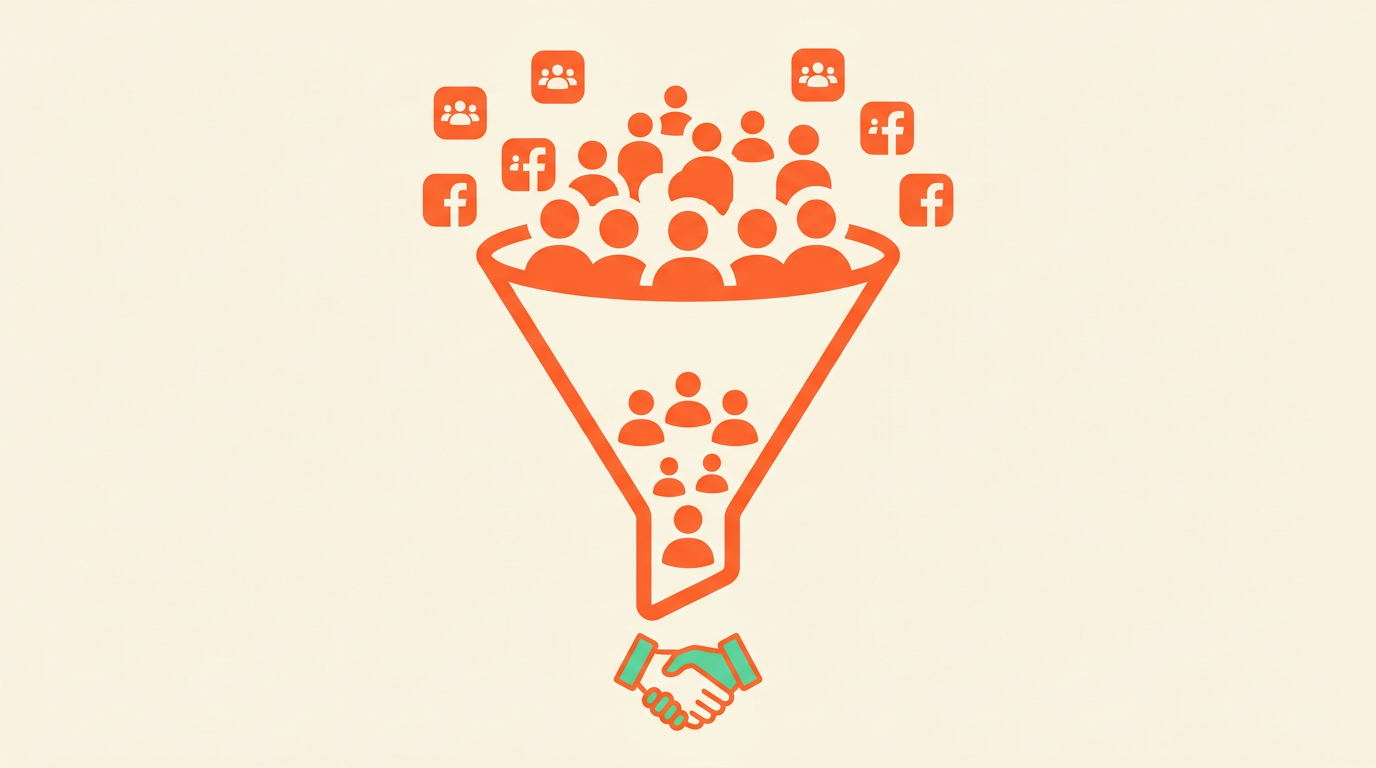
To get leads from Facebook groups: post content that solves a specific problem your ideal client has, use a soft CTA that invites conversation rather than selling directly, optimize your profile so people who click your name land on a mini landing page, and follow up every comment and DM with value before any pitch. The groups are the audience. Your content is the filter. Direct messages are where the actual conversion happens.
Most businesses that try Facebook group marketing give up after a few months because they treat groups like a distribution channel for promotional posts. They post. No one responds. They post again. Still nothing. They conclude that Facebook groups don’t work for their business.
What’s actually happening is that they’re pitching to cold audiences who have no reason to trust them. The businesses generating consistent leads from groups are playing a different game — one that looks slower at first but compounds significantly over time.
This guide is about that different game.
Why Facebook Groups Produce Warmer Leads Than Other Channels
When someone clicks on your profile after seeing your post in a group, they’ve already qualified themselves. They were interested enough in what you wrote to want to know more about you. That’s a different starting point than a cold ad impression.
People in Facebook groups are there because they care about the topic. A “Freelance Copywriters” group is full of people who identify as copywriters or want to become one. A “Real Estate Investors UK” group is full of people actively involved in or interested in property investment. You’re not casting a wide net and hoping to find someone relevant. The relevant people are already gathered.
The trust dynamic in groups is also different from social media broadly. Members interact with each other as peers. When you post genuinely useful content in a group, you accrue social proof with that audience. People remember names they’ve seen provide value. By the time someone DMs you after seeing your post, they’ve often seen your name multiple times before and already formed a positive impression.
The Three-Part Conversion Framework
Getting leads from groups breaks down into three connected parts: content that attracts the right people, a profile that converts the click, and a follow-up sequence that turns conversations into clients.
All three need to work. Strong content with a weak profile loses people at the click. A great profile with bad follow-up loses them in the DM.
Part 1: Content That Attracts the Right People
The goal at the content stage is to identify people who have the problem you solve, not to sell to everyone.
Problem-First Content
The post types that generate the most valuable leads are ones that reference a specific problem. When you post “Does anyone else find it exhausting to manually post to dozens of Facebook groups every day?” in a marketing group, you’re not pitching. You’re naming a pain point. Every person who comments “yes, I feel this” or “this is my biggest time sink” has self-identified as a potential lead.
Their comment is permission to continue the conversation. You respond to each comment, engage genuinely, and build from there.
Result-First Content
Sharing a specific result you achieved for a client is one of the highest-performing content formats in group marketing. The format is: here’s who the client was (general enough to protect privacy), here’s the problem they had, here’s what we did, here’s the specific outcome.
The specificity is what makes it work. “We helped a business triple their reach” means nothing. “We helped a Dallas-based real estate agent go from posting to 12 Facebook groups manually to reaching 340 groups automatically, which generated 28 new property inquiry leads in 30 days” is a story people can picture themselves in.
Every vague claim in a post is a trust-reducing statement. "We help businesses grow" competes with every other business in the group. "We help coaches and consultants book 5-10 more discovery calls per month by posting daily to Facebook groups they're already in" is specific enough that anyone who fits the description immediately identifies themselves and pays attention.
Soft CTAs That Don’t Get Posts Removed
Direct selling in most groups gets your post removed immediately. Soft CTAs that invite conversation keep posts live and generate inbound messages.
Effective soft CTAs by type:
Comment-based: “Comment ‘strategy’ below and I’ll send you the full playbook we use with clients.”
Curiosity-based: “Happy to share the exact steps if anyone wants to know more — just say so below.”
Question-based: “Curious — is this something your business is working through? Would love to hear what’s worked for others.”
Profile-based: “Full breakdown in my profile for anyone who wants the details.”
The comment-based CTAs have an additional benefit: every comment boosts the post’s algorithmic reach, so the more people respond, the more people see the post. You’re building a feedback loop.
Some groups explicitly prohibit any self-promotion, including soft CTAs that link to your profile. Others allow promotion only on designated days. Violating these rules repeatedly results in removal from the group. For a detailed breakdown of what's allowed and what gets you banned, see the guide on Facebook group posting rules.
Part 2: Profile Optimization for Conversion
Your Facebook profile is the first landing page most group leads visit. Most people’s profiles are an afterthought. Treat it like a sales asset.
The Featured Section
Facebook lets you pin items to a Featured section at the top of your profile. This is prime real estate. Pin:
- A link to your website, booking page, or lead magnet
- A compelling post with social proof (a client result, a case study)
- A video introduction if you have one
When someone clicks your name from a group post, the featured section is the first thing they see. Make it count.
Your Bio
Your bio has one job: tell the person reading it exactly who you help and what outcome you deliver. Not your job title. Not your company name. The outcome.
Weak: “Founder at Digital Marketing Agency | Facebook Ads Expert” Strong: “I help coaches and consultants book more clients using Facebook groups — without spending a dollar on ads.”
The stronger version is a lead filter. Anyone who fits that description reads it and thinks “that’s me.” Anyone who doesn’t fit moves on.
Recent Posts on Your Profile
If your most recent public profile posts are unrelated to your business, people who click through from a group won’t make the connection. Keep your last 3-5 public posts relevant to what you do. Share insights, results, behind-the-scenes content from your work.
Part 3: The Follow-Up Sequence That Converts
This is where most group marketers lose leads they’ve already earned. They get a comment or a DM, respond quickly with a pitch, and the conversation dies.
The correct sequence builds trust before asking for anything:
Step 1: Deliver immediate value. When someone comments or DMs asking for more information, give it to them fully and without conditions. If you promised a guide, send it. If you offered to explain something, explain it completely. Don’t hold anything back hoping they’ll book a call first.
Step 2: Ask one specific qualifying question. After delivering value, ask something that helps you understand their situation. “Out of curiosity, what’s your current group posting setup — are you doing it manually or have you tried any tools?” This question opens the door to a genuine conversation and gives you information about whether there’s a fit.
Step 3: Continue the conversation or offer a call. If their answer reveals a real problem you can solve, introduce yourself more specifically and suggest a conversation: “Based on what you’ve described, this is something we work on directly with clients. Would it make sense to jump on a 20-minute call this week so I can understand your situation better?”
If there’s no fit, say so honestly. “Based on what you’ve shared, I don’t think this would be the right fit for you right now, but I’d suggest [alternative approach].” This honesty builds more goodwill than a forced pitch, and the person remembers you positively.
| Lead Source | Lead Temperature | Typical Conversion Timeline | Recommended First Response |
|---|---|---|---|
| Comment on your post | Warm | 1-3 conversations | Engage publicly, then DM with value |
| Direct message inbound | Hot | 1-2 conversations | Deliver promised value immediately |
| Profile click (no contact) | Cold | Multiple future posts | Continue showing up in groups |
| Reply to your comment | Warm | 2-4 conversations | Continue thread, offer to move to DM |
Scaling the Lead Generation
The challenge with this approach is that it works — but manually. When you’re posting to 20 groups and getting 5-10 comments per post, you can respond personally to every one of them. When you’re posting to 200 groups and getting proportionally more engagement, the response volume becomes difficult to manage manually.
The solution isn’t to respond less thoughtfully. It’s to automate the distribution side while keeping the human engagement side manual. NinjaPoster lets you auto post to Facebook groups on schedule using its auto-post to groups feature. You write and send the posts automatically. You respond to every comment and DM personally.
This is the actual model: automated reach, human conversion. Machines handle distribution. You handle relationships.
For a step-by-step guide on setting up the automation side of this model, see the post on how to post to multiple Facebook groups at once.
- Facebook group leads are warmer than cold ad traffic because they've self-selected into a relevant community and seen your content before reaching out.
- Problem-first and result-first content formats generate the most qualified engagement. Specificity is what separates high-performing posts from generic ones.
- Soft CTAs (comment triggers, curiosity invitations, profile references) outperform direct promotions and are less likely to get posts removed.
- Optimize your Facebook profile like a landing page: featured links to your offer, a bio that names who you help and what outcome you deliver.
- Deliver full value before asking for anything in follow-up. Withholding to force a call erodes trust and kills conversations.
- Ask one qualifying question after delivering value. The answer tells you whether to continue toward a call or send someone elsewhere honestly.
- Automate distribution, keep conversion human. NinjaPoster handles the posting. You handle the relationships.
Related Reading
- The Facebook Group Marketing Strategy That Actually Works in 2026
- How to Post to Multiple Facebook Groups at Once (2026 Guide)
- Facebook Group Posting Rules: What Gets You Banned and How to Stay Safe
- What Is Spintax and How to Use It for Facebook Group Posts
- 10 Facebook Group Post Templates That Actually Get Clicks
- How to Use AI to Write Facebook Group Posts That Get Engagement
- Facebook Group Posting Schedule: Best Times and Frequency for 2026
Ready to automate your Facebook group marketing?
NinjaPoster posts to hundreds of groups automatically — safely and organically. Start your 7-day trial today.